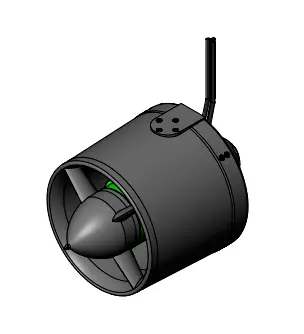
Ducted propulsor
The surrounding duct protects the propeller and provides a defined mechanical mounting envelope.

Vortex propulsion
The Vortex family scales from compact 6S platforms to 10S higher-power builds. Standard ESC and RC PWM compatibility keeps control integration direct and serviceable.
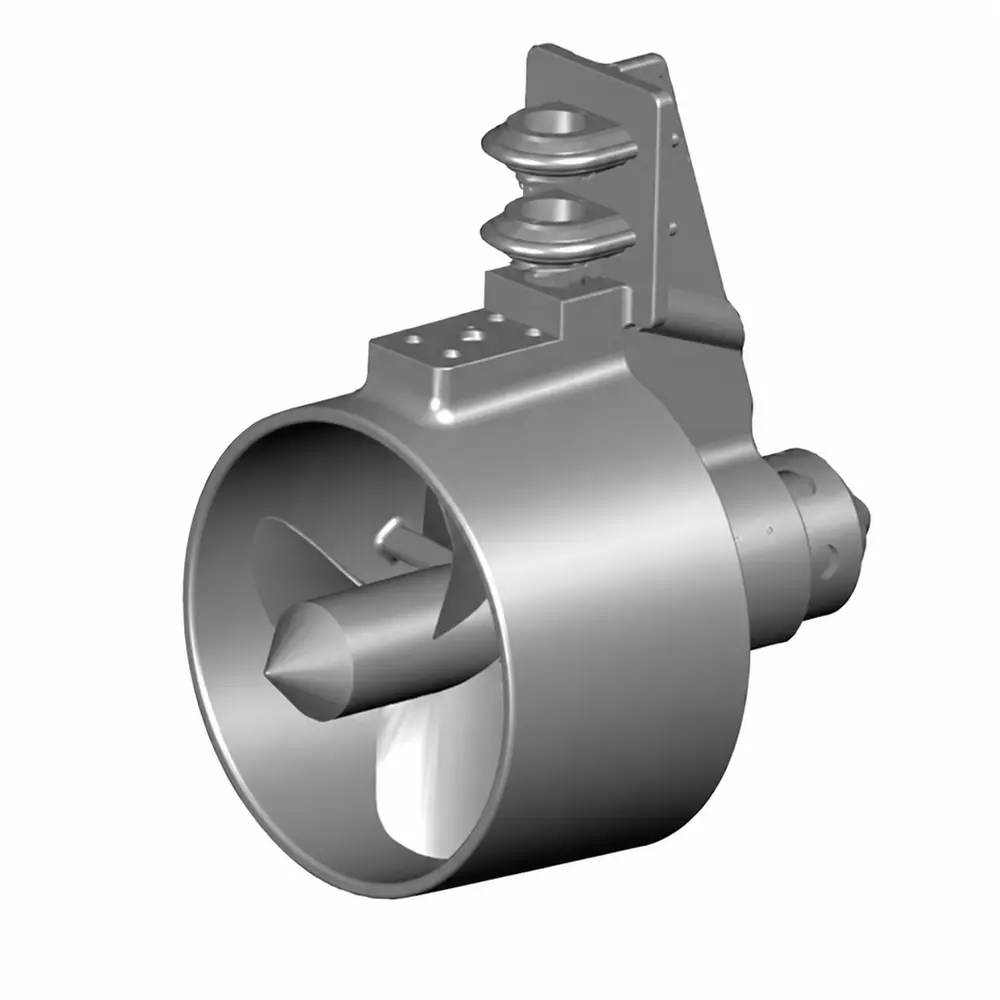
Three power classes
Select a thruster around platform size, operating voltage and mission load. Final sizing should follow measured thrust, vessel resistance and endurance requirements.
Vortex 400 and Vortex 1100 use an outrunner motor architecture. Vortex 2000 uses an inrunner architecture for the higher power class.
| Model | Power | Battery | Status |
|---|---|---|---|
| Vortex 400 | 400 W | 6S | Production-development priority |
| Vortex 1100 | 1.1 kW | 10S | Prototype complete |
| Vortex 2000 | 2.0 kW | 10S | Prototype complete |
Design priorities
Vortex development focuses on protected propulsion, repeatable mounting and direct compatibility with common electric USV control hardware.
The surrounding duct protects the propeller and provides a defined mechanical mounting envelope.
Sensorless brushless motor control supports standard forward and reverse ESC integration.
Nautix and other compatible flight controllers can provide standard propulsion commands.
Documented mechanical, power and signal interfaces support replacement and platform reuse.
Control path
The control path stays familiar to ArduPilot and RC integrators. Nautix provides the command, the ESC handles motor drive, and the Vortex thruster produces bidirectional propulsion.
Product development
Roboteering is prioritizing Vortex 400 production development, followed by Vortex 1100. Higher-power models remain available for engineering discussion as testing and production planning continue.
Measure electrical load, thermal behavior, speed and control response under defined conditions.
Develop measured bollard-thrust curves and operating envelopes for each production configuration.
Move housings and critical parts toward repeatable tooling, machining and quality checks.
Send your vessel mass, target speed, duty cycle, battery voltage and operating environment for an initial Vortex discussion.